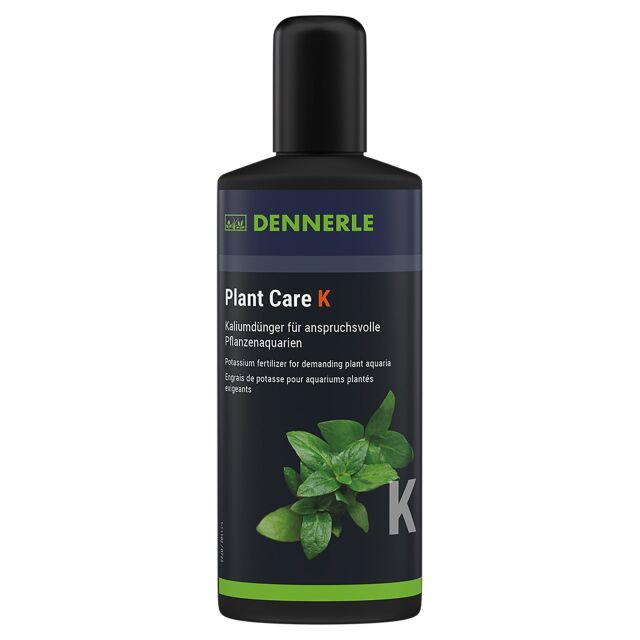
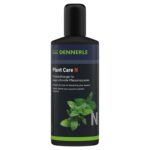
Dennerle Plant Care K is a potassium macronutrient fertiliser for planted and demanding aquariums.
Potassium has a variety of functions in the plant. It is present in high concentrations both in the cells themselves and in the vascular system. Potassium is an osmotically active ion that is crucial for building up root pressure and cell pressure (turgor). Furthermore, it is involved in various metabolic processes, e.g. the synthesis of sugars, starch, cellulose and lignin. Potassium can be stored in the plant cells and transported within the plant when needed, e.g. from older to younger leaves. A certain amount of potassium is supplied by tap water. The harder the water, the more; the softer the water, the less. You can find out the content from your local water supplier. Potassium is only introduced into the aquarium in very small quantities via food and fish excretions. Good aquarium fertilisers (micro-nutrient fertilisers / complete iron fertilisers) such as Dennerle Plant Care Pro therefore always contain an appropriate amount of potassium. This is usually sufficient for normal, planted community aquariums. For demanding planted aquariums, however, (e.g. aquascaping aquariums, Holland aquariums) the situation is different. They have an above-average nutrient requirement, especially for macronutrients. This is due to the large amount of aquatic plants and the low fish stocking in the aquarium.
Potassium deficiency can occur in these types of aquariums, especially in soft water. It mainly shows on the older leaves. When needed, the element is transported from the older leaves to the younger leaves via the vascular system. Typical symptoms are yellowing (chlorosis), which can appear in spots or over a large area between the leaf veins or at the leaf margin. Later, the tissue dies in spots or over a large area (necroses). Some plants are particularly sensitive to low potassium levels. Well-known examples are the parrot leaf (Alternanthera) and the cognac plant (Ammania). Growth can suddenly stop and the newly formed leaves are crippled. In the case of the Indian hygrophila (Hygrophila polysperma), potassium deficiency shows up on the older leaves in the form of small black spots (necroses).
It therefore makes sense for demanding plant aquariums to keep an eye on the potassium content and supplement it if necessary. Each aquarium has a specific nutrient consumption depending on the amount of plants, plant species, animal stocking, feeding, water changes and growth conditions (amount of light/lighting time, CO2 addition, filter technology, etc.). The required amount of fertiliser should therefore be determined individually for each aquarium.